Crows Outperform Primates in Critical Decision Speed
New research reveals that crows utilize the same decision-making logic as monkeys but process visual information at double the speed.
By Lucia Orlov ·
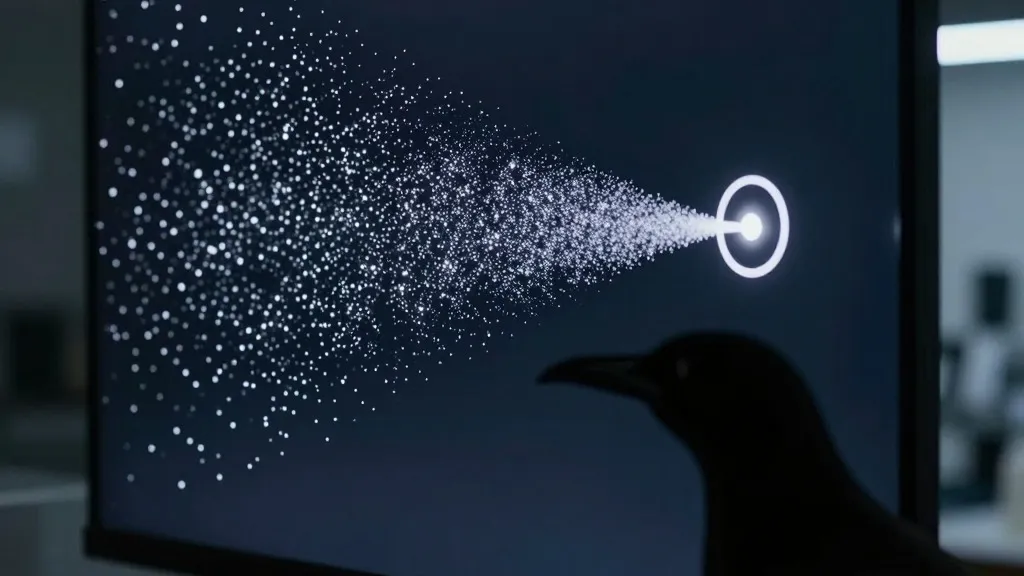
Crows reach complex decisions twice as fast as monkeys while employing identical mathematical logic, a finding that reshapes our understanding of avian cognition. This breakthrough emerges from a study that pits birds against the standard benchmarks used in primate neuroscience for decades.
The core of the investigation centers on the random-dot-motion task, a rigorous test of visual processing. Subjects observe a cloud of flickering specks drifting weakly in a specific direction. The subject must identify the movement and commit to a choice. In primates, this process involves neurons in the neocortex accumulating evidence until firing rates cross a specific threshold. Birds lack this neocortex, which previously left a significant gap in scientific knowledge regarding how avian brains handle similar cognitive demands.
Andreas Nieder, a neurobiologist at the University of Tübingen, described this gap as the central puzzle of the research. He noted that the key question was how a differently organized avian brain could encode decisions. To answer this, Nieder and colleague Philipp Schmidbauer tested two hand-raised carrion crows. The birds sat before a touch-sensitive monitor displaying white dots on a black background. They indicated their choice by pecking targets flanking the display, with a correct answer earning a mealworm.
The experimental design mirrored the primate version with precision. The team intentionally kept the setup identical to ensure valid comparisons. The only procedural difference was the response method: crows pecked to indicate their decision, whereas monkeys used eye movements. Researchers varied the difficulty by adjusting the percentage of dots that moved coherently. The easiest condition featured 81 percent coherent movement, while the hardest involved just 3 percent, a level barely distinguishable from random noise. A zero percent condition was also included to test for guessing.
The results confirm that crows solved the task using the same fundamental logic as primates. Despite the stark structural differences in their brain organization, the birds relied on comparable processes to integrate visual evidence over time. This discovery indicates that a brain without a neocortex can achieve decision-making parity with mammals. More importantly, the crows accomplished this at twice the speed of the monkey subjects, suggesting a highly efficient neural architecture for processing visual data.
This finding carries significant implications for the broader field of neuroscience. It challenges the assumption that specific brain structures are necessary for certain types of logical processing. By demonstrating that such a different neural system can achieve the same outcome with greater speed, the study highlights the versatility of evolutionary adaptations in cognitive functions.
Source: Ars Technica