Harvard physicists cap lunar city size at 10,000 based on water reserves
A new analysis suggests the moon's available water supply cannot sustain a million residents for more than a century, even with high-efficiency recycling systems.
By Alexander Novak ·
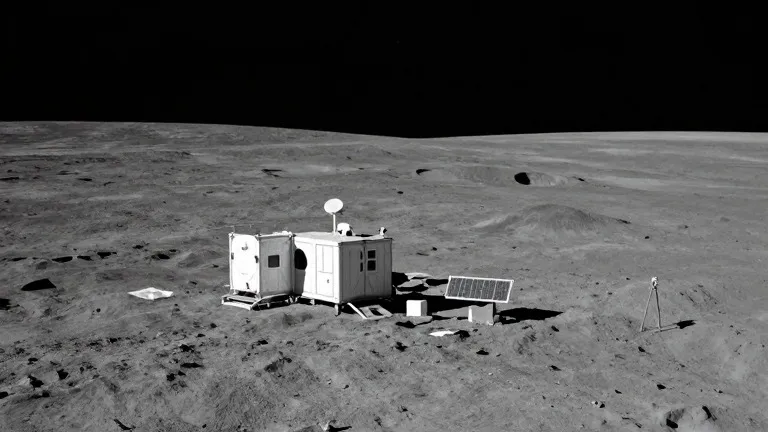
The prospect of large-scale human habitation on the moon faces a physical limit, according to a study published in Frontiers in Space Technologies. While power generation appears sufficient for a million inhabitants, the available water supply restricts sustainable population growth to roughly 10,000 people for centuries.
Martin Elvis, a senior astrophysicist at Harvard University's Smithsonian Astrophysical Observatory, and Jonathan McDowell, an honorary professor at the Durham University Space Research Centre, conducted the analysis. They examined the feasibility of supporting large populations on the lunar surface by assessing two key resources: power and water. Their findings indicate that solar and nuclear energy sources can support one million people, but water availability dictates the maximum long-term population size.
Current estimates suggest the moon holds approximately one billion tonnes of water, primarily located in permanently shadowed regions at the poles. Under the assumption that 98 percent of this water is recycled, a rate comparable to the International Space Station, a population of one million would exhaust these reserves in about 100 years. In contrast, a settlement of 10,000 residents could remain sustainable for centuries under the same conditions.
Elvis described the estimated water volume as modest relative to the needs of a large city. He compared the total amount to an aquarium the size of Central Park filled until the Statue of Liberty is just underwater. "It's a small lake," Elvis said, "and a small lake is not going to supply a big city for very long." McDowell added that expanding cities across the lunar surface would require transporting water to other locations because it is not currently distributed widely.
The researchers' baseline estimate of one billion tonnes may be overly optimistic. Elvis noted that the figure could be 20 or 30 times too large and that only a fraction of the water is recoverable. If the usable water amount is only one percent of the initial estimate, the lifespan of a million-person city would shrink to one year. Gordon Osinski, a professor of planetary geology at Western University, cautioned that satellite measurements carry uncertainties and that the water may exist as sub-millimetre ice crystals mixed into soil, making extraction difficult.
These findings follow public statements by space industry leaders. In February, SpaceX CEO Elon Musk stated the company shifted its focus from Mars to building a self-growing city on the moon within ten years. Blue Origin CEO Jeff Bezos has claimed that millions of people will live in space by 2045. McDowell said the new data should not discourage exploration but rather inform practical planning. "The truth is never negative," McDowell said. "What's negative is to actually go and try and do something that isn't going to work."
Source: CBC News