Kyiv Death Toll Hits 140 as Subways Become Sleep Halls
Russian strikes on warehouses and power grids have forced 4 million residents into underground shelters and caused supermarket shortages.
By Alexander Novak ·
Kyiv military administration data shows 140 people died in the capital during the first eight months of 2026. That figure already exceeds the 172 deaths recorded across the entire previous year. If the current monthly average continues, 2026 will mark the deadliest year for the city since the full-scale invasion began in 2022.
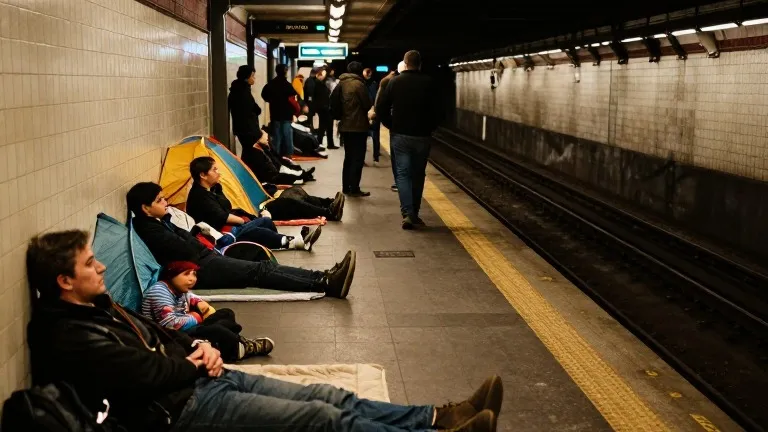
Shelter capacity in Kyiv cannot accommodate its population of 4 million. Residents now use subway stations as overnight quarters. Approximately ten people per station lay out mattresses and erect small tents each night. Children and pets occupy the cold concrete walls alongside adults. Halyna, a resident of the Lukyanivka district, takes her five-year-old son Roman to the nearest station most evenings. She noted that her family remains alive and lucky despite repeated targeting of their area over the past four years and eight months.
Strikes on logistics infrastructure have disrupted consumer markets. Russian attacks on warehouses have created supermarket shortages comparable to levels seen only in the early months of the war. Emergency power outages returned at the end of September. A recent Russian attack disabled the subway system. The damage to energy infrastructure raises questions about the city's ability to supply heat, electricity, and water reliably during the coming winter.
School operations face logistical hurdles. A drone struck a school building in southwestern Kyiv in early October, though staff and students were already in shelters. Principal Valentyna Chorna reports that the school maintains in-person classes for grades one through nine because its shelter holds more than 500 students. Attendance depends on siren duration and shelter availability. Parents report difficulty balancing work duties with child safety, as alerts can begin at any time during school hours.
A September drone strike on an apartment building in the central Pechersk district killed 14-year-old Daniel Umanskyj while he completed homework. Vlad, a neighbor in the hallway with his daughter at the time, credited their late arrival for saving their lives. He described the attackers as monsters who do not care who they kill. Flowers now stand outside the damaged building in memory of the boy.
The Kyiv International Institute of Sociology surveyed residents in September. The report indicated that 72% of city inhabitants were prepared to endure the conflict as long as necessary. Local authorities have adjusted civil procedures to maintain routine. The daily curfew now runs from 1 a.m. to 5 a.m. Some facilities operate during yellow alerts. Red alerts, which signal ballistic or cruise missile threats, require immediate sheltering.
Daily life in Kyiv has shifted from relative calm to a pattern resembling front-line zones. The city continues to absorb impacts on housing, education, and supply chains as the strike pattern intensifies.
Source: Deutsche Welle