Razer Basilisk V4 Pro Adds AI Key and 200-Hour Battery
The $169.99 mouse cuts weight to 100 grams but shifts thumb buttons, raising questions about ergonomics for average hand sizes.
By Alexander Novak ·
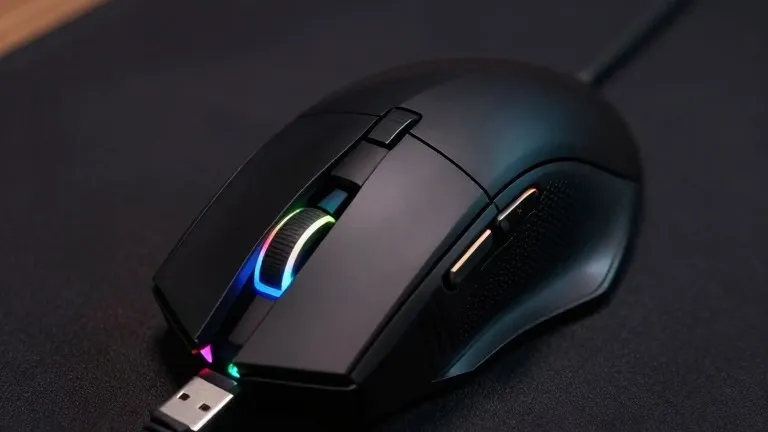
Razer has released the Basilisk V4 Pro, a refresh of its popular gaming mouse that introduces a dedicated AI button and extends battery life to 200 hours. While the device drops in weight and improves endurance, a detailed review by Sarah Jacobsson Purewal, senior editor at Tom's Hardware, indicates that the new layout creates ergonomic friction for many users.
The primary conflict in the design centers on the addition of two new programmable keys, bringing the total to 12. One key is located beside the left mouse button to switch profiles, while the other, a third thumb button, defaults to opening an AI prompt. Purewal noted that the profile button is positioned at the front edge of the 127.5mm device. For individuals with medium-sized hands and long fingers, this placement is too far forward to press comfortably without stretching.
The AI button presents a more persistent issue. Because it matches the size of the existing thumb controls, it pushes the entire cluster backward. This shift moves the fourth mouse button (MB4) into a position that is difficult to reach. Although the buttons are remappable, Purewal found the default arrangement awkward, stating that all three thumb buttons felt slightly off during testing. The review also questioned the necessity of a dedicated AI prompt key on every peripheral.
Despite these layout changes, the mouse offers notable physical improvements. The black model weighs 100 grams, a reduction of 12 grams compared to the 112-gram Basilisk V3 Pro 35K released in October 2024. Purewal described the lighter device as easier to pick up, though not ultralight. The device connects via 2.4GHz wireless, Bluetooth, or USB-C and utilizes Razer's Focus Pro 50K optical sensor.
Performance metrics remain high. The sensor supports up to 50,000 DPI and 930 IPS, tracking effectively on most surfaces, including glass panels at least 4mm thick. The fourth-generation optical switches are rated for over 100 million clicks. In testing, the switches produced no misclicks or double-clicks. Purewal concluded the shape suits a wide range of games, from MMOs to competitive shooters, though it may not be optimal for top-level competition.
Battery life has increased from 150 hours on the previous model to 200 hours at a 1,000 Hz polling rate over 2.4GHz wireless. At the maximum 8,000 Hz polling rate, the battery lasts 54 hours. The mouse also features a tilt wheel with two tactile modes (24 and 48 steps) and a free-spin mode. The free-spin setting was found to be too sensitive, often causing unintended backscrolling, while the precision tactile mode received praise.
Priced at $169.99, the Basilisk V4 Pro launched alongside the Mouse Dock V2 Pro, a separate accessory sold for $69.99. The dock provides wireless charging and includes an integrated 8,000 Hz receiver with eight RGB zones. It is compatible with several older Razer mice. The mouse box includes a USB-A dongle, an adapter, and a 6-foot braided cable, but does not include a flexible HyperFlex cable or grip tape.
The Basilisk V4 Pro is positioned between the DeathAdder V4 Pro and the more button-heavy Naga V3 Pro. It retains the right-handed, contoured shape and RGB lighting of previous iterations. The review identifies the reduced weight, extended battery life, and general feel as key strengths. The main drawbacks cited are the impact of the AI button on thumb ergonomics, the price point, and the device's slightly large dimensions.
Razer's decision to integrate AI functionality directly into the hardware marks a shift in how gaming peripherals are designed. By adding a dedicated key, the company places a new layer of interaction on a tool traditionally focused on raw input speed. The trade-off appears to be a compromise in the physical layout for the majority of users, as the thumb cluster is now crowded by an additional control that may not suit every hand shape.
Source: Tom's Hardware