College stadiums hide local history
Groundbreaking projects and game day traditions reveal graves, mascots, and famous legends beneath major FBS football venues.
By Hassan Lawson ·
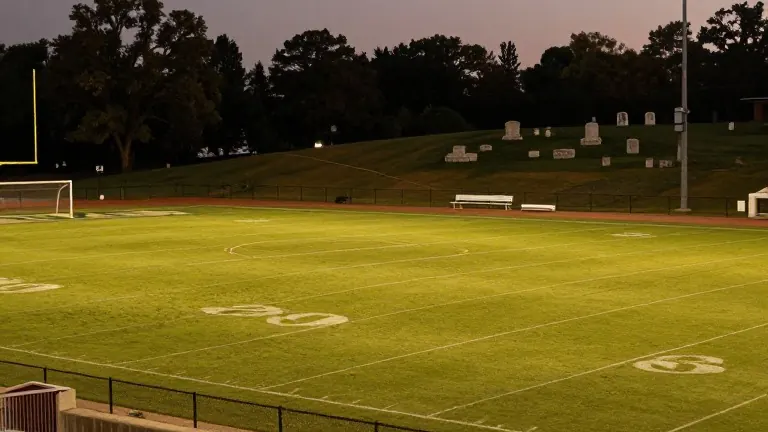
Fans entering major college stadiums this fall may stand on ground that holds more than just turf and concrete. Archaeological digs and long-standing campus lore indicate that several prominent venues sit directly on top of historic burial sites, active forensic facilities, and the final resting places of beloved mascots. These physical layers of history coexist with the current athletic programs, creating a tangible connection between the modern game and the local geography.
Construction work at The Citadel in Charleston, South Carolina, uncovered more than 50 unmarked graves during a summer drainage project on the eastern side of Johnson Hagood Stadium. The site was originally Tower Hill Cemetery, where over 26,000 residents were buried starting in 1841. The university purchased the land in 1960 and has continued to find remains, including 341 bodies relocated in 2005. Julie Bowling, a local resident and alum, noted that the previous owners erased the bodies rather than moving them formally.
Tennessee’s Neyland Stadium has a more active connection to death. The university’s forensic team, known as the Body Farm, buried donated bodies in the dirt beneath the grandstands from the 1940s until 2017. At peak capacity, more than 1,000 skeletons were housed in a classroom building that now supports the visiting sideline area. The remains are currently located across campus, but the facility continues to study decomposition on a nearby hillside visible from the stadium.
Other schools incorporate deceased mascots into their game day rituals. Oklahoma interred its dog mascot Mex in 1928, and the university canceled classes for three days to honor the loss. Georgia’s Sanford Stadium features a mausoleum in the player tunnel housing every Uga bulldog. Texas A&M placed the headstones of Lady Reveille dogs near the north end zone of Kyle Field, originally allowing them a view of the field before the area was closed off and replaced by a scoreboard.
Ghost stories also persist at these venues. At Indiana’s Memorial Stadium, staff report seeing the spirit of a student who died in 1960. Kansas State’s Nick is said to haunt the cafeteria where he died in 1960. At Notre Dame, students report hearing phantom footsteps and seeing the figure of George Gipp, who died of pneumonia in 1920. These legends are often cited by coaches and fans to set the mood for high-stakes games.
The most famous Halloween moment in college football history occurred at LSU’s Death Valley. In 1963, Billy Cannon returned a punt 89 yards against Ole Miss. The play secured a victory for the Tigers and helped Cannon win the Heisman Trophy. That specific game is often cited as the defining example of how the autumn season can determine a player’s legacy.
Environmental factors also play a role in the stadium experience. Texas A&M’s Kyle Field is home to thousands of Mexican free-tailed bats that have roosted there since 1927. In Austin, an estimated 1.5 million bats live under the Congress Avenue Bridge, where they are frequently seen swooping near fans after games in October.
Source: ESPN