NHTSA Proposes Cyan Lights: Federal Standard for Driverless Cars
The agency wants to replace a patchwork of signals with a single blue-green indicator to show when a robotaxi is operating.
By Lucia Orlov ·
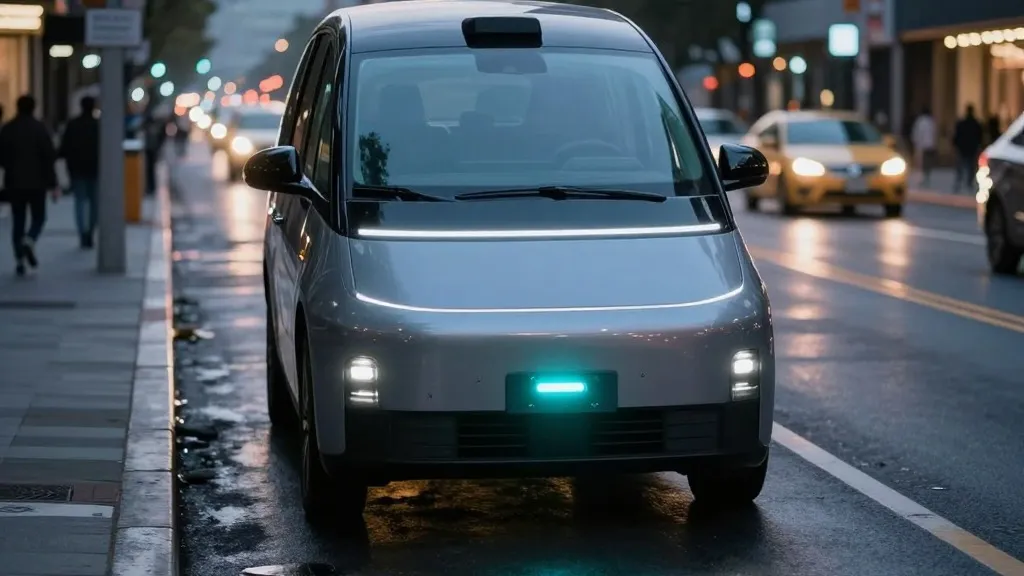
The National Highway Traffic Safety Administration has proposed a specific blue-green light, known as cyan, to indicate that a vehicle is being driven by an automated system. The agency released proposed amendments to Federal Motor Vehicle Safety Standard No. 108 on October 23, 2026. This standard governs vehicle lighting. The new rules would create a national standard for how autonomous vehicles communicate with other road users.
The proposal aims to solve a long-standing debate in the autonomous vehicle industry. Companies have struggled to determine how to visually distinguish driverless cars from those with human drivers. NHTSA states that the cyan marker lamps would clearly signal to law enforcement and the public when an automated driving system is in control. The color choice avoids conflict with existing traffic signals. Red, amber, white, and flashing blue or red lights are already used for braking, turn signals, headlights, and emergency vehicles.
The agency is also simplifying the regulatory framework for cars without human drivers. Current federal rules require physical controls that are often unnecessary for autonomous systems. The proposal would remove requirements for physical hazard switches, manual beam shifters, and turn levers. These controls are designed for human operation. NHTSA would also update the 12.8-volt testing standard. This change would allow manufacturers to build around modern LED systems without facing administrative hurdles. The agency is also considering dropping rules that dictate whether high-beam lights must sit above or below low-beam lights.
The cyan lights would be optional for manufacturers. However, if a company chooses to install them, it must adhere to federal requirements for color, brightness, and placement. This approach prevents a patchwork of different signals from emerging across the industry. NHTSA wants companies like Waymo, Nuro, and Zoox, as well as automakers including GM and Mercedes, to adopt the same configuration. The goal is to ensure that any driverless car on the road looks consistent to pedestrians and other motorists.
There is some existing precedent for this type of signaling. Mercedes-Benz won state-level approval for turquoise lights on its Level 3 Drive Pilot vehicles. The automaker has since dropped that specific approach in favor of a Level 2++ system. NHTSA sees these state-level efforts as a starting point but wants a unified national standard. This would provide a clear legal framework for the entire sector.
The changes fit into a wider push by the Department of Transportation. The agency wants to speed up the deployment of autonomous vehicles. The government is working to make it easier for automakers to build cars without traditional controls. Steering wheels and pedals are designed for human drivers and may be removed in future models. The new standard supports this shift by focusing on how these vehicles signal their status to the outside world.
Regulators are still enforcing existing rules as written while the proposal moves through the process. Last month, NHTSA opened an audit query into the Tesla Cybercab. The agency is examining the process and technical data Tesla used when certifying the vehicle. The concern centers on the absence of certain design features. Current federal standards require sideview mirrors, pedals, and a steering wheel. The Cybercab lacks these components, highlighting the gap between current regulations and emerging vehicle designs.
Source: The Verge