Gulf Tanker Traffic Faces Record Monthly Losses Amid Rising Tensions
Twelve maritime incidents in October mark the worst month for shipping security since 2017, according to a Washington-based tracking group.
By Hassan Lawson ·
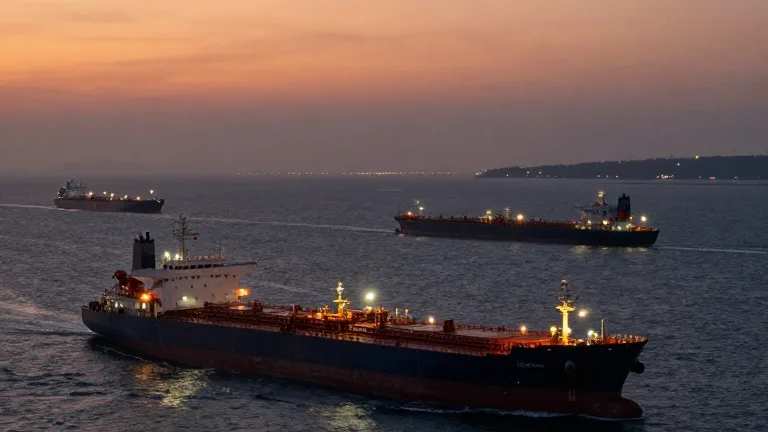
Twelve maritime attacks in October mark the worst month on record for commercial shipping in the Strait of Hormuz and nearby waters, according to data from a Washington-based think tank that has tracked such incidents since 2017. The spike in hostilities coincides with sharp exchanges between the United States and Iran over the ongoing conflict.
Iran's Revolutionary Guard Corps Navy announced that two supertankers struck naval mines while navigating an unauthorised route south of the Strait of Hormuz. Separately, the United Kingdom Maritime Trade Operations reported that a tanker was hit by an unknown projectile seven nautical miles off the Omani coast. These incidents contribute to a broader pattern of risk for vessels moving through critical energy corridors.
On land, the Saudi-led coalition forces stated they intercepted and destroyed a ballistic missile and a drone aimed at Saudi Arabia. The country's Directorate of Civil Defence issued warnings to residents in Riyadh, Najran, and Wadi al-Dawasir, declaring the danger passed minutes later. Such defensive actions aim to protect infrastructure and civilian populations during periods of heightened aerial activity.
Political rhetoric has intensified in parallel with the physical attacks. US President Donald Trump said in Florida that Washington might launch another military operation against Iran. In response, Major General Abdollahi, Iran's armed forces chief of staff, declared that the nation would not allow US warships to re-enter the Persian Gulf. Mohammed Mokhber, an adviser to Supreme Leader Mojtaba Khamenei, described the threats from Trump and Israeli Prime Minister Benjamin Netanyahu as signs of desperation.
Diplomatic efforts continue alongside the military standoff. Iranian President Masoud Pezeshkian is scheduled to travel to Moscow next week to meet Russian President Vladimir Putin and attend the Gas Exporting Countries Forum summit on 27 October. In London, Foreign Secretary Ed Miliband stated that Britain is increasing its push for diplomatic solutions, noting that the conflict is driving up bills for British families.
The regional tension extends to other fronts. Israeli forces in the occupied West Bank forced Palestinian residents of Hebron to leave their homes on foot and demolished buildings near the site where two Israeli soldiers were killed. Troops also detained dozens during raids. In Syria, protests erupted against repeated Israeli incursions in the south, following an attack earlier in the week that killed a man with a disability.
Turkish Foreign Minister Hakan Fidan indicated that the time had come to reunify Libya's rival eastern and western administrations, hinting at a near-future announcement. In Israel, Prime Minister Netanyahu warned that the country should prepare for international banking sanctions and suggested cryptocurrency could help circumvent them, a statement made four days before the Knesset election.
Source: Middle East Eye
More Business · World news · Scam Watch · Report a business · Got a Story?